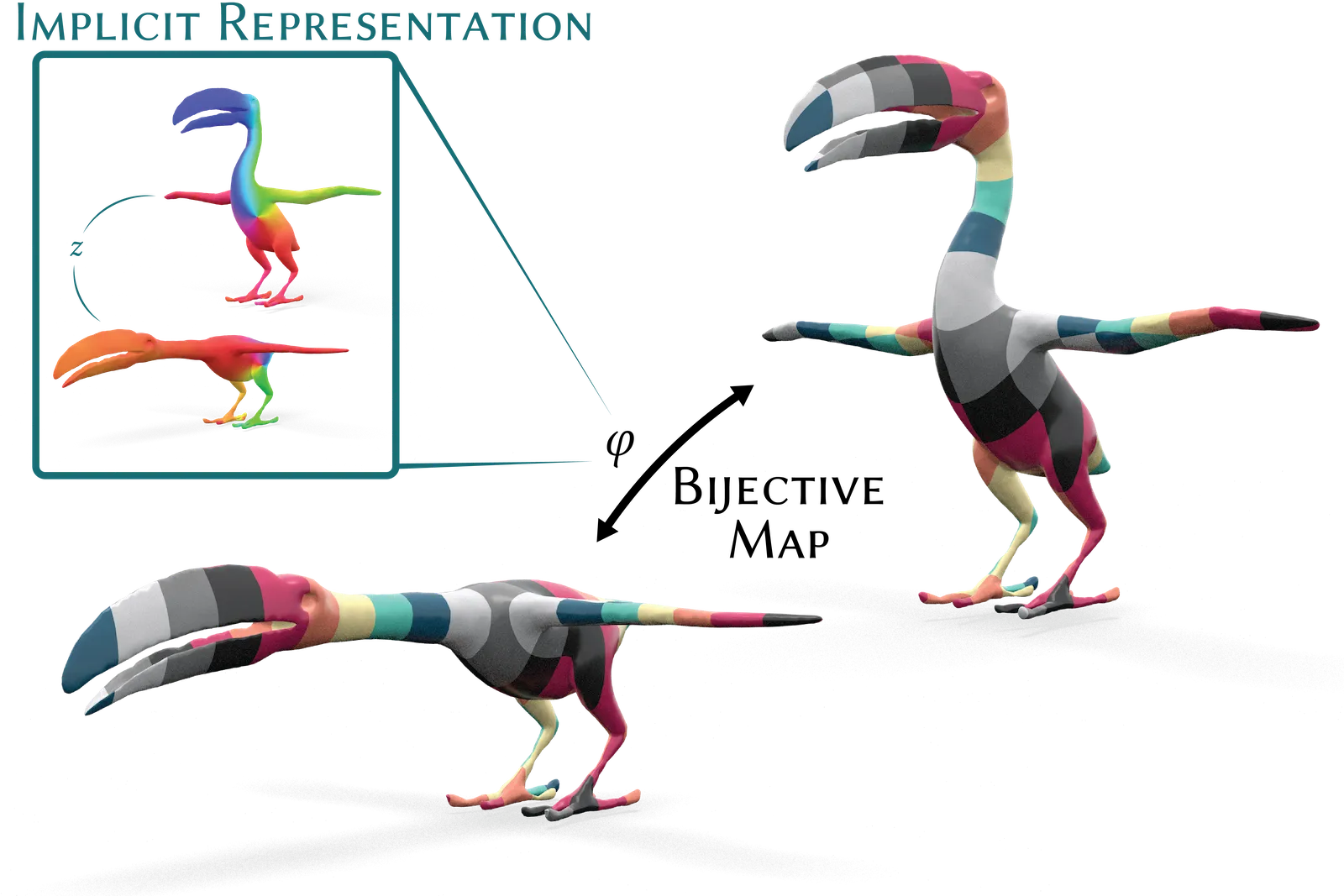
The key idea is that a bijection between surfaces defines a two-dimensional mapping surface sitting inside the four-dimensional product space of the two inputs, and this mapping surface can be stored implicitly as the zero set of a complex section—essentially a complex function defined on the product space. Now the distortion of the map can be optimized by minimizing the area of this mapping surface, which amounts to minimizing the Ginzburg-Landau functional of the complex section. We demonstrate the practical benefits of our method by comparing to state-of-the-art correspondence algorithms and show that our implicit representation offers improved stability and naturally supports constraints that are difficult to enforce with explicit map representations.
Implicit Minimal Surfaces for Bijective Correspondences
Best Paper (Honorable Mention) top 1.5% of submissions.
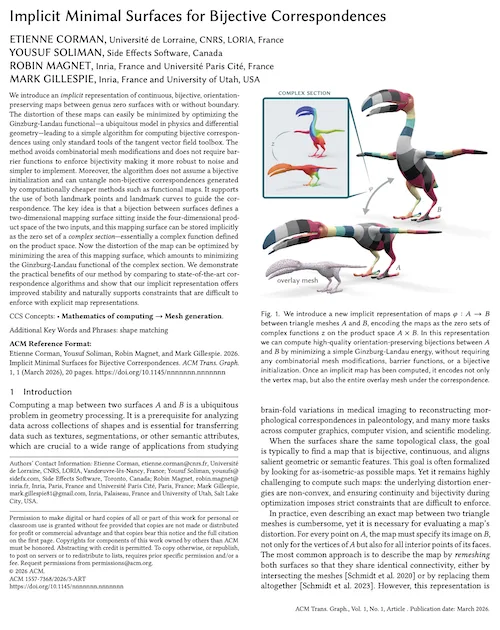
We introduce an implicit representation of continuous, bijective, orientation-preserving maps between genus zero surfaces with or without boundary. The distortion of these maps can easily be minimized by optimizing the Ginzburg-Landau functional—a ubiquitous model in physics and differential geometry—leading to a simple algorithm for computing bijective correspondences using only standard tools of the tangent vector field toolbox. The method avoids combinatorial mesh modifications and does not require barrier functions to enforce bijectivity making it more robust to noise and simpler to implement. Moreover, the algorithm does not assume a bijective initialization and can untangle non-bijective correspondences generated by computationally cheaper methods such as functional maps. It supports the use of both landmark points and landmark curves to guide the correspondence.
Paper
Supplemental
Bibtex
@article{Corman:2026:IMS,
author = {Corman, Etienne and Soliman, Yousuf and Magnet, Robin and Gillespie, Mark},
title = {Implicit Minimal Surfaces for Bijective Correspondences},
journal = {ACM Trans. Graph.},
volume = {45},
number = {4},
articleno = {162},
year = {2026},
publisher = {ACM},
address = {New York, NY, USA},
url = {https://doi.org/10.1145/3811368},
doi = {10.1145/3811368}
}
Acknowledgements
Thanks to Aria Halavati for teaching us about the complex line bundle approach to codimension-two minimal surfaces.