Subgrid Marching Tetrahedra
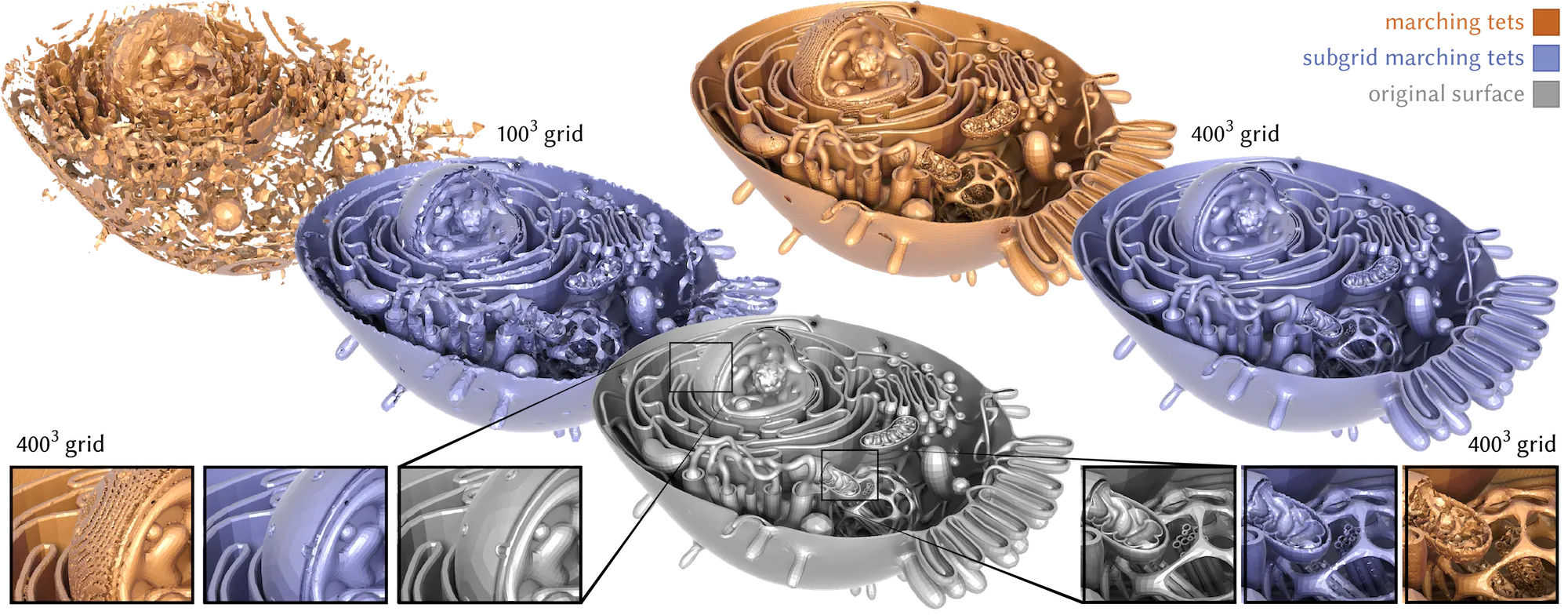
We describe a method for recovering a manifold, intersection-free triangle mesh from the points where edges of a tetrahedral grid pierce a continuous surface.
Unlike classic marching cubes or tets, our subgrid marching scheme allows arbitrarily many surface patches within a single cell, capturing fine features and thin sheets.
Moreover, it requires neither a well-defined inside/outside (allowing surfaces with boundary), nor consistently-oriented input geometry.
Yet we retain the local, parallel nature of classic marching: reconstruction is performed independently per tet, yielding a conforming mesh across tet boundaries.
Our key innovation is a generalization of normal coordinates from geometric topology, which encode surface connectivity via arbitrary integer intersection counts along each grid edge.
This encoding sidesteps the usual Nyquist-Shannon limit, putting no lower bound on the size of features that can be resolved on a fixed grid.
In practice, for similar compute time and equal grid resolution—or even an equal number of output triangles—meshes produced by subgrid marching are far more accurate than those from classic marching.
Beyond standard contouring, our method can be used to convert polygon soup into a manifold, intersection-free mesh.
Paper
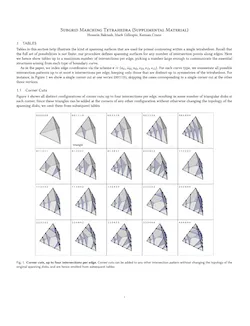
Supplemental Documents
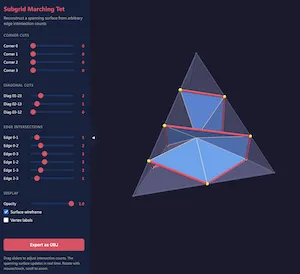
Errata
Chris Wojtan pointed us to prior work in the fluid simulation literature which tackles a similar problem: Fast and Robust Tracking of Fluid Surfaces by Matthias Müller (2009) and Physics-Inspired Topology Changes for Thin Fluid Features by Chris Wojtan, Nils Thuerey, Markus Gross, and Greg Turk (2010) both proposed generalizations of marching tets/cubes to support certain thin features which often appear in the context of fluid simulation. The latter uses a convex hull to fill in each cell, allowing it to reconstruct surfaces with up to 2 sheets per cell. Thus, one can think of these algorithms as living on a continuum—marching tets allows up to 1 intersection per edge, this reconstruction allows up to 2 intersections per edge, and our general formulation extends further to allow arbitrary intersection counts per edge.
Bibtex
@article{Baktash:2026:SMT,
author = {Baktash, Hossein and Gillespie, Mark and Crane, Keenan},
title = {Subgrid Marching Tetrahedra},
journal = {ACM Trans. Graph.},
volume = {45},
number = {4},
articleno = {57},
year = {2026},
publisher = {ACM},
address = {New York, NY, USA},
url = {https://doi.org/10.1145/3811358},
doi = {10.1145/3811358}
}
Acknowledgements
This work was funded by the National Science Foundation under awards 2212290 and 2504890.
The authors wish to thank Dave Bachman, Saul Schleimer, and Eric Sedgwick for helpful conversations.
The soap film image in Figure 5 was generated by Nano Banana Pro [Google 2025], conditioned on a render of a discrete minimal surface.
The marble track model in Figure 18 is designed by Tulio Laanen, and the vase model in Figure 28 by Hiroaki Nishimura.